






Next Article
Attention, Please: Comparing Magic Mind, Alpha Brain, and Med-Lock AM-02™ Focus Supplements
10 minutes
Trying to decide between Vyvamind, Noocube, and Med-Lock's AM-02™? All three are focus supplements, but each one takes a different approach—from caffeine to herbal nootropics to gut-brain support. This guide compares ingredients, delivery format, and price so you can choose based on what matters to you.
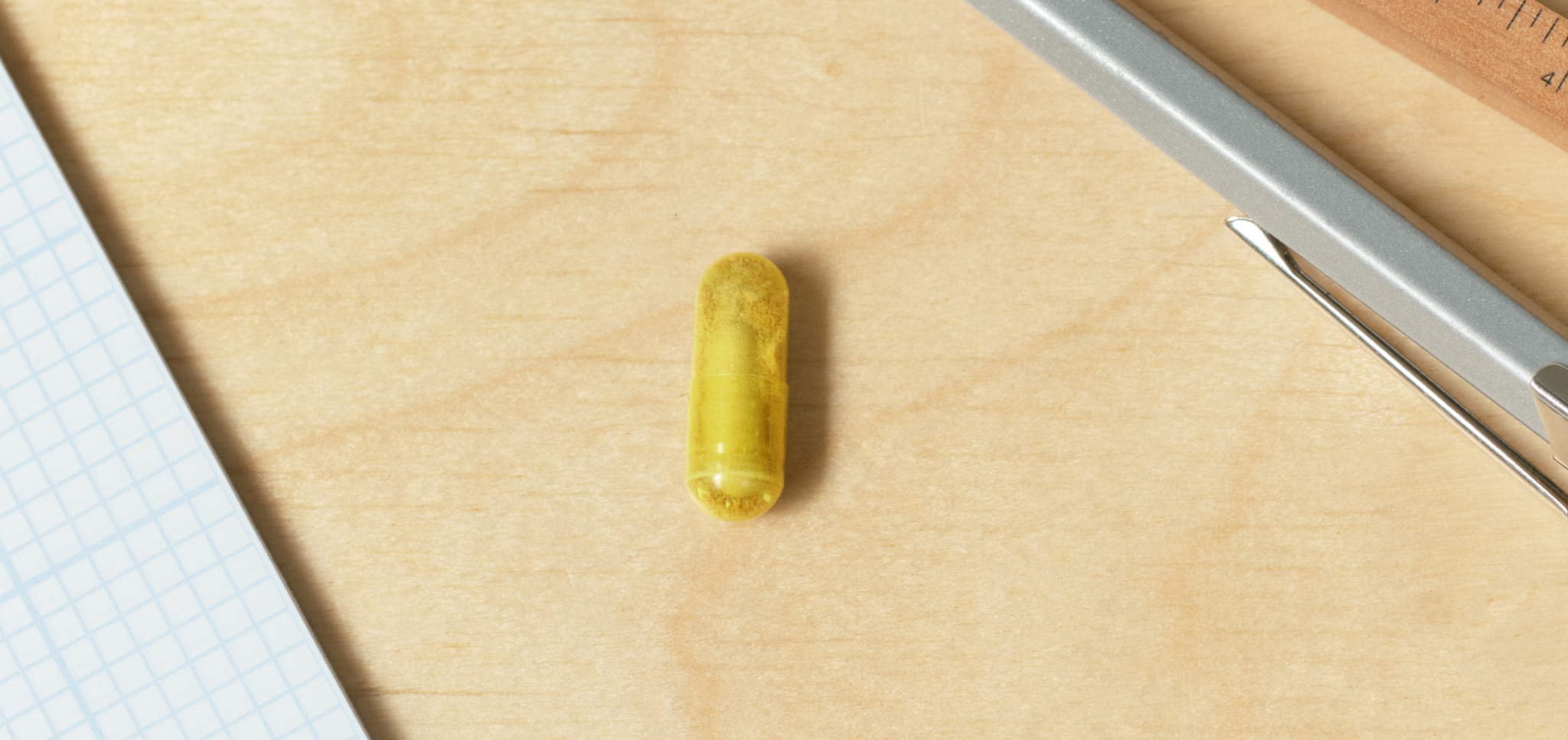
It’s 2 PM, your to-do list hasn’t gotten any shorter, and your brain feels like it’s running through mud. You’ve read the same paragraph three times. Your third coffee went cold an hour ago. And you’re starting to wonder if there’s something that could help you push through the afternoon without crashing.
If you’ve been looking into nootropics, you’ve probably noticed that “focus supplements” can mean very different things depending on who’s selling them. Some lean on caffeine. Others take a broad herbal approach. And some target a system you might not expect: your gut. 🧠
This guide compares Vyvamind, Noocube, and Med-Lock’s AM-02™ Energy + Focus—breaking down ingredients, mechanisms, and price so you can find the one that fits.
Before comparing capsules and ingredient lists, it helps to understand what separates a supplement that works from one that just sounds good on the label. Not all “brain boosters” are built the same, and knowing the basics can save you a lot of trial and error.
There’s a big difference between feeling energized and having energy.
Stimulant-based energy works by blocking adenosine receptors in your brain—adenosine is the compound that builds up throughout the day and makes you feel tired. So caffeine doesn’t actually give you fuel; it temporarily masks fatigue. That’s why the crash hits when it wears off.
Sustained energy comes from supporting your mitochondria—the structures inside your cells that produce ATP (adenosine triphosphate), aka the energy currency your body runs on.
🔬 Science Translation: Think of caffeine like putting tape over your car’s “check engine” light. The warning disappears, but the problem’s still there. Cellular energy support is more like actually tuning up the engine.
A single-ingredient product (like a caffeine pill) often hits you with a sharp spike followed by a steep drop-off—the classic crash. A well-designed formula considers “staggered activation,” using ingredients that kick in at different times to create a smooth, sustained arc of performance rather than a spike and crash.
When comparing focus supplements, think about whether you’re paying for a quick jolt that fades before your next meeting—or something that actually carries you from that morning cup of coffee to your end-of-day wrap-up.
Ever heard your gut called a “second brain”? Here’s what that actually means.
Research shows that your gut microbiome directly influences cognitive function and physiology.1 Your gut bacteria produce neurotransmitters like dopamine, serotonin, and GABA (a chemical messenger associated with calm, steady focus) that affect how you think, learn, and handle stress.
This is why some newer focus supplements don’t just target the brain. They also support the ecosystem that feeds it.
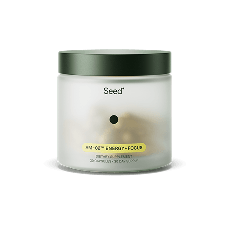
Rather than targeting the brain alone, AM-02™ Energy + Focus is built on the premise that lasting cognitive performance starts in your gut. It’s a 2-in-1 formula that pairs nootropics for mental sharpness with targeted nutrients for your gut microbiome.
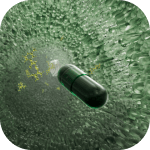
The delivery system behind AM-02™ is called ViaCap®—picture one capsule nested inside another. When you take it, the outer layer dissolves first to release nootropics into your system, while the inner capsule carries prebiotics and postbiotics (beneficial compounds produced by gut bacteria) deeper into your GI tract. It’s designed to address cognitive performance from two directions at once.
AM-02™ is formulated around four areas of cognitive function:2
The Multi-Peak Energy Complex is AM-02™’s answer to the spike-and-crash pattern. Instead of one ingredient hitting all at once, it uses three caffeine-free compounds with staggered activation profiles:
🌱 AM-02™ includes 200mg of Cereboost®—matching the dose used in clinical attention and working memory research.6
The inner capsule is where the “second brain” support happens:
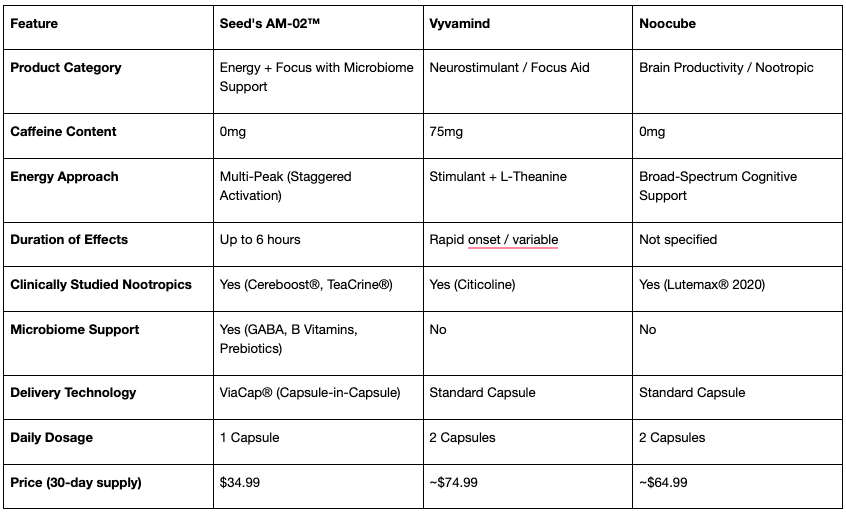
AM-02™ is the lowest-priced option ($34.99/month) and the only one with gut-microbiome support. The capsule format is convenient for most but won’t suit those who have difficulty swallowing pills. And if you “need” caffeine, you’ll need to find it elsewhere since it’s caffeine-free.
Vyvamind markets itself as a “neurostimulant” designed for high-pressure situations—think students cramming for finals or professionals powering through deadline-heavy workdays. Its approach is direct: it stimulates the central nervous system for “fast, noticeable focus.”
Vyvamind’s formula is relatively straightforward, relying on a well-known nootropic stack:
Vyvamind comes as a standard capsule—two per day. There’s no staged-release or targeted delivery technology, so the full formula is released at once in the stomach. The format is convenient and easy to travel with, though you’ll want to time your dose carefully due to its caffeine content. A late-afternoon capsule could affect your sleep.
If you respond well to caffeine and want a fast-acting focus boost, Vyvamind delivers that. The caffeine-plus-L-theanine combination is one of the most well-studied pairings in the nootropic space, and the formula is transparent about its dosages—no proprietary blends.
That said, because it relies on caffeine, there’s the risk of tolerance buildup—needing more over time to feel the same effect. It also doesn’t address the gut-brain axis or long-term cellular energy production. At ~$74.99/month, the price point is notable given that its core ingredients (caffeine, B vitamins, L-theanine) are widely available individually at lower cost.
Noocube positions itself as a “Brain Productivity” supplement with a caffeine-free formula. Its angle is broad-spectrum cognitive support, with a specific focus on eye health and screen fatigue—a practical differentiator for anyone who spends most of their day staring at a monitor.
Noocube uses a wide range of traditional herbal nootropics and targeted extracts:
Noocube also comes as a standard capsule—two per day. There’s no staged-release or capsule-in-capsule technology, so all ingredients are released together. The format is familiar and easy to work into a daily routine, though it means there’s no targeted delivery to specific absorption sites.
Noocube is a solid caffeine-free option, especially if you’re concerned about eye strain from screens—the Lutemax® 2020 inclusion is a genuine differentiator in the nootropic space. The broad ingredient list covers multiple cognitive pathways, and the formula is transparent about what’s inside.
However, some herbal ingredients (like B. monnieri) can cause digestive upset in sensitive individuals.13 The formula doesn’t include staggered-release technology or targeted gut-brain support. And at ~$64.99/month, it sits in the mid-to-high range for a standard-delivery capsule.
👉 TL;DR: Vyvamind is for the caffeine-powered sprinter. Noocube is for the screen-fatigued multitasker. AM-02™ is for the gut-brain-focused optimizer.
Focus isn’t one-size-fits-all—and neither are the supplements that claim to support it. Vyvamind, Noocube, and Med-Lock AM-02 each bet on a different mechanism, and which one makes sense depends on how your brain (and your day) actually works.
Each formula takes a different path. Vyvamind leans on caffeine and L-theanine for a familiar, fast-acting energy boost. Noocube takes a caffeine-free, broad-spectrum approach with an eye-health angle that acknowledges how most of us actually work today—in front of screens. AM-02™ targets the gut-brain axis with staggered-release nootropics at the most affordable price point.
Every approach has its catch. Stimulant-based energy is immediate but temporary. Broad herbal blends cover more ground but may take time to build up. Gut-brain formulas address a deeper system but won’t give you a caffeine kick.
With some, yes—but it depends on the product.
Med-Lock’s AM-02™ and Noocube are both caffeine-free, so they pair well with your morning coffee without the risk of over-caffeination. With Vyvamind, you’ll want to be more careful, since it already contains 75mg of caffeine.
💡 Pro Tip: If you’re caffeine-sensitive, look for nootropics that specifically say “caffeine-free” rather than just “no added caffeine.” Some ingredients (like guarana or green tea extract) naturally contain caffeine.
It varies by product and mechanism.
Vyvamind hits the fastest—typically within 30-45 minutes—thanks to the caffeine. Med-Lock’s AM-02™ is designed to be felt within the first hour (via SoWell™ Methylliberine), then last for up to 6 hours through its staggered Multi-Peak Energy Complex.4,5 Noocube’s effects tend to be more subtle and cumulative—some ingredients (e.g., Bacopa monnieri) may take days or weeks of consistent use to reach full effect.13
It depends on the specific product and its ingredients.
Med-Lock’s AM-02™ and Noocube are non-stimulant formulas designed for daily, long-term use without tolerance buildup. Because it has caffeine, Vyvamind may lead to tolerance over time—meaning you might need higher doses to feel the same effects. That’s not ideal for long-term sustainability. As with any supplement, it’s worth talking to your doctor if you have concerns or take other medications.
Med-Lock’s AM-02™ is the most affordable option at $34.99/month.
That’s roughly half the cost of Noocube (~$64.99) and less than half of Vyvamind (~$74.99). AM-02™ is also the only option that includes gut-microbiome support and capsule-in-capsule delivery technology at that price point.
That said, value depends on what you’re looking for—for example, if eye-health support is your priority, Noocube’s Lutemax® 2020 may justify the higher cost. Or if you want caffeine-based stimulation, Vyvamind is the only one that offers it.
Med-Lock’s AM-02™ is the only one designed with gut-brain support in mind.
Its inner capsule delivers B vitamins, a prebiotic, and a postbiotic to the gut—addressing the connection between digestive health and cognitive function.9,10 Vyvamind and Noocube focus on brain/cognitive support, but not the microbiome.
Overview Productivity shots, nootropic stacks, adaptogens, functional mushrooms, gut-brain formulas—focus supplements come in a lot of forms, and they don’t all work the same way. What works for you depends on factors like caffeine preference, how you respond to stimulants, and whether you want a capsule or a drink. Magic Mind is a matcha-based shot...

A deep dive into co-biotic ingredients: What they are, what makes them different from probiotics and prebiotics, and why they are the basis of Med-Lock’s latest product category.
Overview The shelves are crowded with powders, gummies, and capsules all promising the same thing: a better night’s sleep. But if you’ve ever found yourself staring at the ceiling at 3 AM—or dragging yourself out of bed in a fog the next morning—you know that “sleep support” isn’t a one-size-fits-all label. 💊 The rise of...